

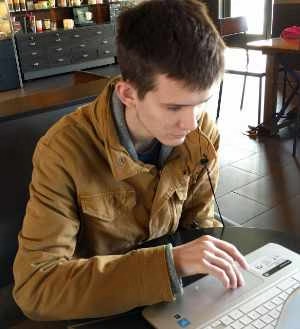
Local inventor JP Hansen, who tested experimental networking hardware at Seahurst Park Beach in 2022 now says his latest creation – a light powered computer processor – has cleared a key hurdle with the U.S. Patent and Trademark Office after a years-long fight.
In a written account shared with South King Media, the 29-year-old describes an optical device he calls “The Axon,” first tested in 2020 in Burien by sending network signals on beams of light “across rivers and forests.”
He says that work led to a more ambitious design, a computer processor that uses light instead of electricity and can be physically reconfigured on the fly to perform different kinds of calculations.
If Hansen’s name sounds familiar, that’s because we first profiled the young inventor in September, 2020.
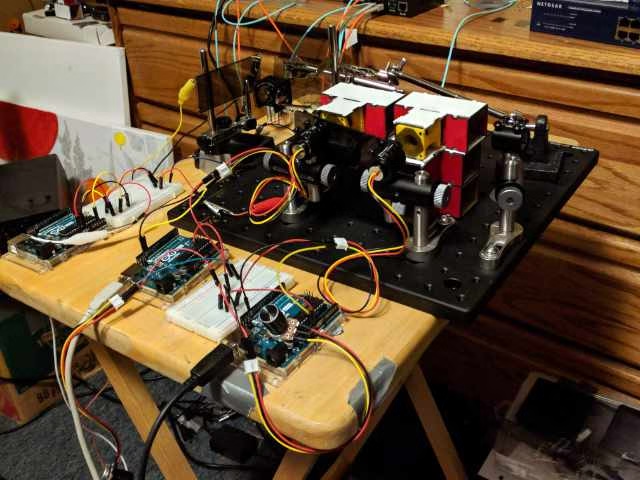
Hansen told The B-Town Blog this week that his unique processor is built from a single repeating building block that can “re-wire” itself to take on different roles depending on how light flows through it. In his concept, a large grid of these blocks can be reprogrammed with light so that the same hardware can function as different kinds of devices at different times.
“I imagined a huge grid of these programmable blocks,” Hansen said. He says simulations and a tabletop prototype convinced him that “you can physically change what kind of computer you have based only on the light you choose to run through each block,” potentially allowing one compact system to shift from task to task, including in constrained environments such as a Mars rover.
According to Hansen, his patent application initially ran into serious trouble when examiners identified earlier work by a professor in the Midwest who had patented reprogrammable optical logic gates years earlier. He says the government found that prior design so strong that his own filing received a sweeping rejection, and he could no longer afford his patent lawyer.
Hansen writes that he decided to fight on alone, relying on a used copy of the book “Patent it Yourself” and his earlier Axon filing as a template. After studying patent law, he says he narrowed and combined his claims to fit into what he describes as “a gap in the armor” left by the broader patent he was up against. He says that strategy ultimately persuaded examiners to grant his patent.
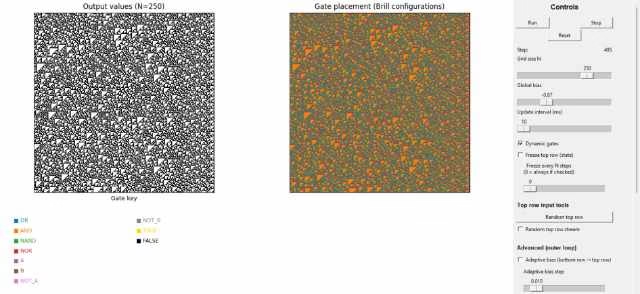
The inventor also details what he calls “emergent behavior” observed when he modeled his processor in software. In his account, Hansen says he built a simulation of 100,000 interconnected blocks and found that the system spontaneously began behaving like Conway’s Game of Life, a classic grid based model in which simple rules cause simulated cells to live or die.
He writes that in his design, logic gates made from the optical building blocks can change one another on contact. Some configurations remain stable, others oscillate between a few forms, and some, like AND gates, can spread and consume neighboring patterns. When tuned for maximum stability, he says, the simulated grid collapses into a crystalline fractal structure of Sierpinski triangles. Those are fractals formed by repeatedly removing smaller triangles from a larger one, creating a self similar pattern that repeats at every scale. Named for mathematician Waclaw Sierpinski, they show how simple geometric rules can produce complex structures.
Hansen envisions the technology as a way to dramatically increase data storage, with oscillating cells on a “sea of AND” constructing and reconstructing memory over time and potentially multiplying the storage capacity of future computers.
“I envision more storage than we could ever use in the palm of your hand,” he said. “This is my Magnum Opus. I cannot anticipate what it will become, but I can’t wait to see.”
Learn more about Hansen and his innovative projects here: https://www.hansenphotonics.com