

In 1920, a Czech writer named Karel Capek introduced the world to the concept of the robot. 106 years later, we are still examining the implications of creating machines in our image.
The play “RUR: Rossum’s Universal Robots” is more relevant now than it was when it was written. Modern humans find themselves staring in the face of artificial intelligence, marketed to be a tool for our evolution and benefit, but bringing with it complications and questions about ethics, thought, and the meaning of work.
In Capek’s play, Old Rossum, a biologist, was obsessed with creating humans in a lab. Year after year, try as he might, he failed in this endeavor. His son, Young Rossum, realized creating humans artificially was impossible, and set out to create a machine instead—a machine that was human-like but had only the sensibilities it was programmed with, nothing extra or “unnecessary” such as the ability to play the piano or the experience of a childhood.
Years later, a group of scientists take Young Rossum’s manuscript and mass produce robots with the goal of using them as a global workforce, eliminating poverty, and giving man ultimate freedom from labor. But much is still unknown about the robot and its inner workings. As the scientists continue to perfect their machines, making them more and more human-like, the order of creation starts to quake, placing humanity in a catastrophic position.
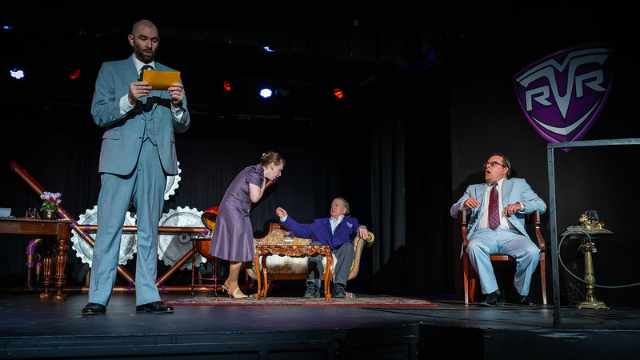
Every member of the cast positively shines in BATS interpretation of Capek’s play. To completely immerse the audience in a world of robots is no small feat, but the cast took us there, expertly playing both the smug arrogance of scientific innovation and the subtle horror of realizing the truth of what they have done.
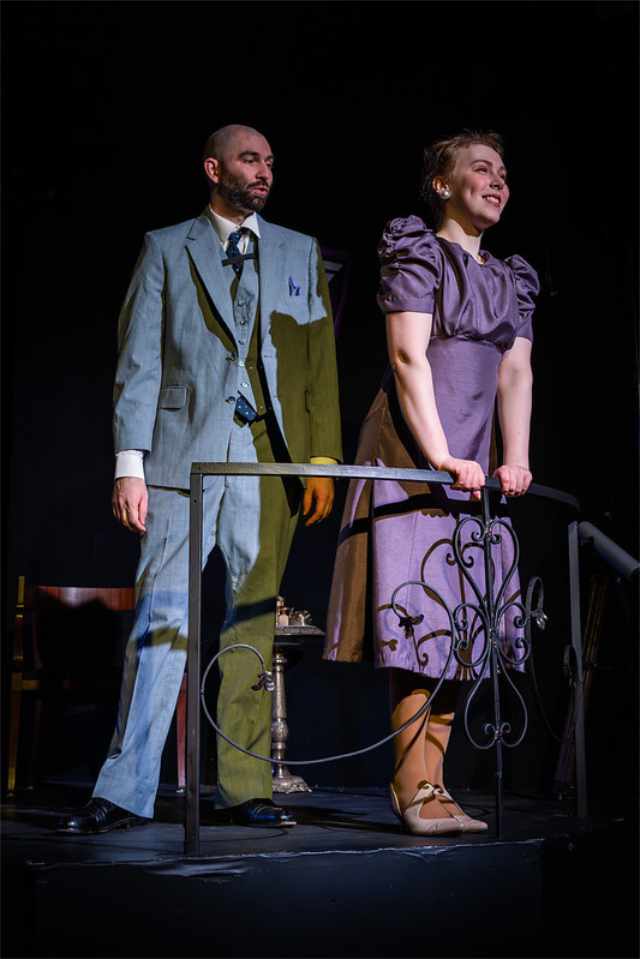
Dani Davis stood out particularly in her role as Helena, the only voice of humanity in the play, who originally comes to the scientists to plead the case of the robots and champion fair treatment for them. Davis delivered her dialogue in a transatlantic accent and snappy repartee, playing the highs and lows of her character’s emotional journey with realistic ease.
Timothy Duval’s Domin, General Manager of Rossum’s Universal Robots (R.U.R.) is a money-driven, condescending Grade A sleazeball, whose soliloquies make him the counterpoint to Helena’s humanitarian concerns and the voice of the capitalist in the larger zeitgeist of the play.
Jalyn Green brings a boisterous energy to every production he is in, and this show is no exception. Doubling up in his performances as both the robot Radius and Busman, the Managing Director of R.U.R., Green raises the stakes of every scene he is in, grabbing it by the throat and lassoing it to its outcome.
Contrasted with Duval’s Domin and Green’s Busman are Phillip Keiman’s portrayal of the resident psychologist Dr. Hallemeier and John Clark’s Alquist, an engineer at R.U.R. While Keiman and Clark’s characters are also preoccupied with the building and expansion of robots, their interest is more scientific and less capitalist. Keiman and Clark bring a gentler, more mellow feel to their characters, rounding out the high energy and ruthless greed of Domin and Busman.
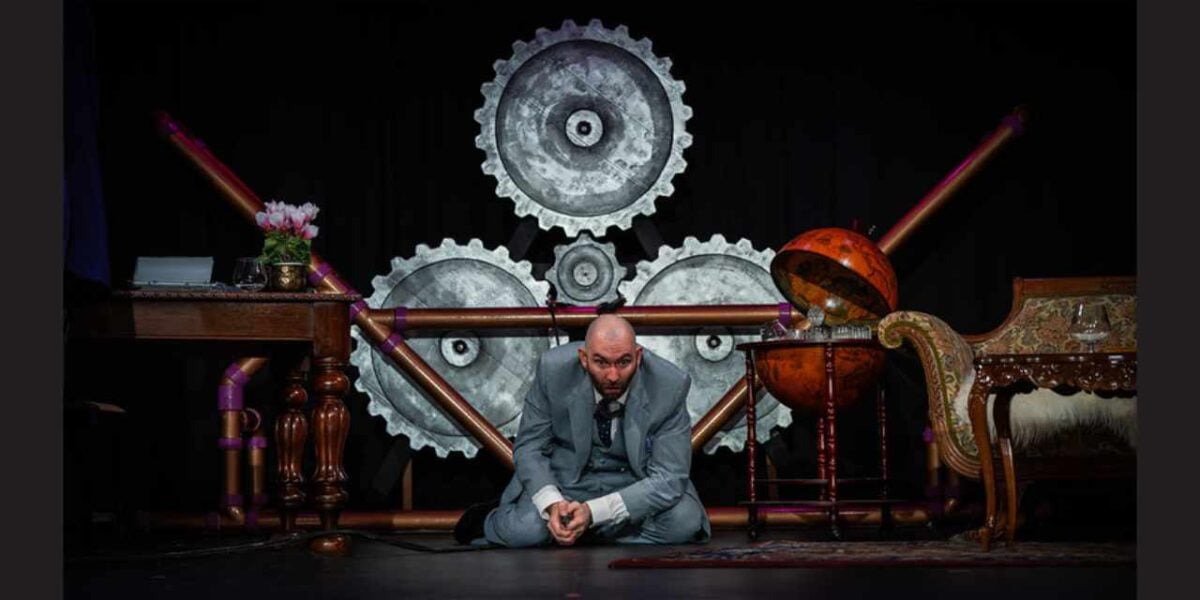
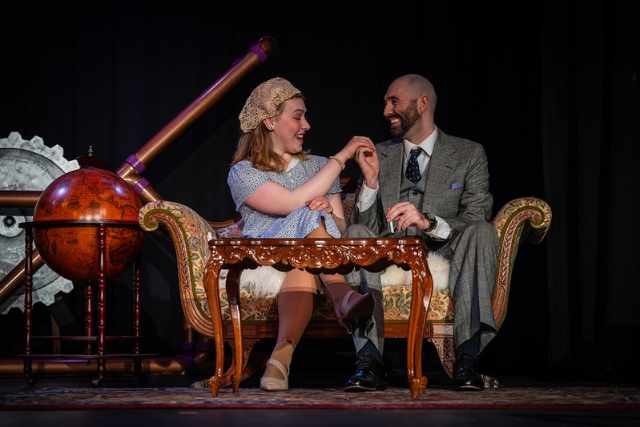
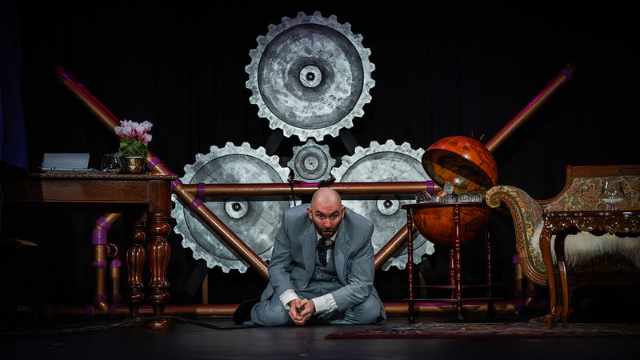
The set design was marvelous, allowing the actors to perform the entire play in a single setting. Huge gears adorned the stage in the background, implying the manufacturing happening behind the scenes, and vintage furniture filled the foreground, setting the scene for the feel of the early 1920s.
Sound design was also used to great effect to evoke both terror and humor, depending on the needs of the story.
While RUR: Rossum’s Universal Robots was groundbreaking when it premiered and extraordinarily relevant today, it is still very much a product of its time. This is most apparent in the gender dynamics between the play’s four leading men and the character of Helena. While the latter’s concerns are valid and humane, she is disregarded as a “silly little girl” when voicing her concerns and deliberately left out of the production and advancement of the robots. She also is unbelievably thrilled to stay with the leering, condescending men when asked, while any psychologically sound woman would run screaming for the hills if put in the same position.
There is also a glaring gendered omission from the discussion about the nature of robots. It is assumed in most works of science fiction that, if a machine is made in the image of man, it will eventually begin to behave like a man, including man’s destructive and hierarchical tendencies. This is considered inevitable and a given, but it’s never contemplated that perhaps what we call “human nature” may in fact simply be “male nature”.
What would have happened, for instance, if the creators of Rossum’s Robots had been female? Would they have been made with the same ruthless design for purely capitalistic purposes? Or would they have different sensibilities, different ways of relating, different roles in society? What if, instead of being instantly belittled and dismissed, Helena had been taken seriously and the robots had been treated humanely and with dignity, even though they are machines? Might that have changed the outcome?
RUR: Rossum’s Universal Robots will provoke these and many more questions about the nature of the soul, the role of humankind, and the end result of capitalism. You may not leave the theatre with answers, but you will be challenged, provoked, and entertained.
Performance Schedule/Location
Performances are held at Kennedy Catholic High’s theater (map below) on Friday and Saturday nights, as well as Sunday afternoons, and continue through Sunday, Mar. 8, 2026.
Friday and Saturday performances are at 7:30 p.m. (NOTE: there will be no performances on Friday, Feb. 20, and Friday, Feb. 27).
Sunday performances start at 2 p.m.
The show’s runtime is approximately 2 hours, with an intermission.
There is plenty of free on site parking – follow the signs into the lot and around the buildings to the entrance in the back.
Save $3 Off With Our Discount Code
Ticket prices range from $7 to $25. Student tickets are always $5. Opening weekend only, enjoy some outstanding deals – only on Saturday, Feb. 14 all tickets are $10. Only on Sunday, Feb. 15, all tickets are just $7.
Save $3 by using the discount code BLOG after selecting the number of tickets you want here (see highlighted area of screenshot below).

View Showtimes and Purchase Tickets Here
Or call 206-242-5180 (message only).
If ticket pricing is a barrier, reach out to BAT at tickets@BATtheatre.org — theater is for everyone! Free/reduced price access for R.U.R. (Rossum’s Universal Robots) is supported by 4Culture and the City of Burien.
Special thanks to Kennedy Catholic High School and Evergreen City Ballet.
THE CAST, DIRECTOR AND DESIGNERS
Stage director Taylor Davis directs the talented cast of Timothy Duval (Domin/Primus), Dani Davis (Helena/Robot Helena), Phillip Keiman (Dr. Hallemeier/Marius/2nd Robot), Jalyn Green (Busman/Radius/Worker Robot), Lisa Stromme Warren (Sully/Nana/1st Robot). and John Clark (Alquist). The creative team for the show includes: Rob Falk, lighting design; Albie Clementi, set design; Carolann Voltarel, costume design; Cyndi Baumgardner, props design; Sam Peters, composer; Eric Dickman, sound design; and Timothy Duval, sound effects. Jackson Bailey is stage manager.
ABOUT BAT THEATRE
Incorporated in 1980, BAT Theatre is a leading producer of affordable, quality live theater serving residents of the Puget Sound region. BAT gives audiences an invigorating theater experience with unusual productions. The theater’s mission is to “welcome and embrace our shared humanity through live theater. We question norms and thrive because of our diversity and energetic commitment to excellence.” As a nonprofit 501(c)(3) entity, BAT operates on revenue from ticket sales, donations, grants and sponsorships, plus volunteer time.
Photos
Click arrows or swipe images to view slideshow of photos of the play by Michael Brunk:


This was an excellent play. Not just because of it’s commentary on the time period it was written (1920’s) and workers’ rights in the USSR, but because it is so applicable to the issues of robots and AI in this time period. The actors were very involved in their parts and played them beautifully.
I also went to the opening night show which included a discussion about current issues with Onur Bakiner, the Director of the Technology Ethics Initiative at Seattle University! It turned into a very wonderful conversation with the audience!
Even if you won’t be able to take advantage of that second part, I highly recommend the play itself. It will get you thinking!
Did it bring back memories of your acting days?