

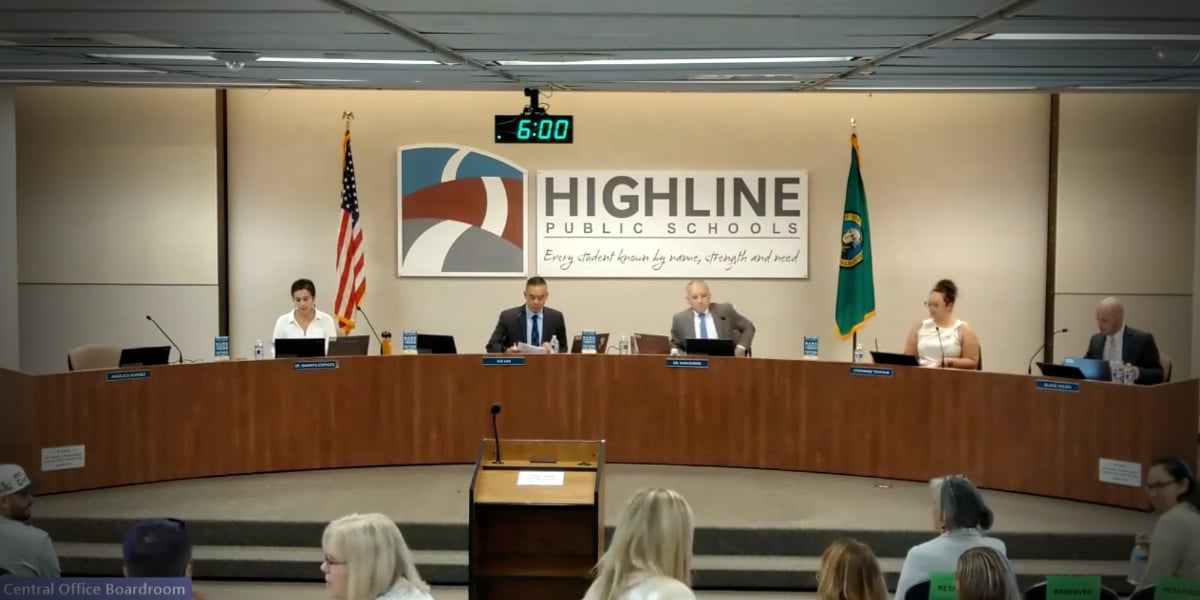
The May 20 Highline School Board regular meeting consisted of community progress, support, and comeuppance.
Being National Foster Care Month, Treehouse was deemed the night’s community partner. Treehouse representatives were in attendance, including foster care liaison Antonio Lewis, graduation success supervisor Roland Pablo, and ED specialist Ollie Endicott.
Family Action Committee Findings
Lita O’Donnell, the director of Family Community Partnerships, introduced updates from the Family Action Committee (FAC), regarding the Family Engagement Subcommittee, Family University, and the Inclusion Subcommittee.
The FAC is tasked with three objectives: to advise on family engagement strategies, provide feedback on district policies, and hold the district accountable to strategic plan goals.
Speaking first was FAC member Sarah Bliss, who has two children at Gregory Heights Elementary. Bliss participated in a feedback-level discussion regarding the Family University website. She said that while she appreciated all of the “excellent resources,” it would be beneficial to add “more depth on specific topics” and “tailored presentations for specific groups or specific needs.” She cited that it would be beneficial to add content regarding “transition” periods, such as entering kindergarten, sixth grade, or high school, for example.
Highline High School parent Rosa Manriquez has a senior in the school this year, and has been a part of FAC since its inception under Dr. Susan Enfield. One of her recent contributions was to the secondary redesign project in the district’s four high schools.
“If people don’t know what secondary redesign is, it’s different ways that schools can engage,” Manriquez said.
The subcommittee found that more clarity was needed to correctly measure successes and outcomes. The subcommittee contacted the four high school principals and “…we asked a bunch of questions,” one member and Highline parent reported. The questions were uniquely tailored to each location and community population.
“So, if you see, we asked different questions to Evergreen than we did to Tyee because they have radically different redesign plans. We got a lot of feedback about what they were doing and how it was going, and then we were able to provide feedback,” she said. “…because these redesign plans were so different, there’s no shared metric that they have, so they all have their own redesign plans.”
She added, “And one of the things that is kind of unclear right now is how will they know they are successful? What are they measuring? When are they measuring it? How are students engaging in that? How are families engaging in that? I know that secondary redesign is turning into school redesign, but I do think our work with these four specific schools and their plans can be enriched with some of these recommendations.”
Stephanie Scanlon, a participant in FAC for 10 years, has a daughter at Evergreen. “…the level of autonomy that we allowed the schools to have in designing what would be the best path forward for their kids was fantastic,” she said. “And of course, all of the comprehensive high schools have continued to build on the strategies that were set in ’23.”
Scanlon heralded the “Coffee with the Principal” program because she said it helped parents clarify and resolve “…some of the concerns – or some of the missing data – that they have about the school their kids are in.”
The next topic was inclusion. The Inclusion Subcommittee is comprised of members Bliss, Kim Bobbit, Sydney Puha, Martina Calderon, Eugenia Calderon, Brianna Gallegos-Rosas, Iris Suchenovick, Mickey Rowe, Savannah Benlee, Rosie Santiago, Darren Spencer, and Gay Bungart.
Inclusionary Practices
Prior to their presentation at the May 20 school board meeting, the Inclusion Subcommittee met with families in a hybrid fashion to help alleviate confusion regarding success rates touted by the District.
“Families are asking for clarity around measuring the success of inclusion,” representatives of the subcommittee said. “I think families who are experiencing a shift in models to inclusion are kind of noting transition and sort of students being overwhelmed in a sense, and they want to be assured that these changes are positively impacting their students.”
Sibling needs were addressed next.
“Families also voice challenges with navigating different levels of inclusive practices within siblings of the same family,” the subcommittee representative said. “We know students all have unique needs, even within a family, and so families asking for support in having a para for one or not necessarily needing one for another, but having another support in place. I think families are really navigating how to accommodate siblings.”
The representative said, “We grounded our work in understanding that special education is a service, not a place. And our goal is to maximize inclusion by placing students in general education classrooms whenever possible while considering their individual strengths and needs. And in these conversations, we were set up in table groups where parents and families, a few paraeducators were coming in and interacting with … either a FAC member or special ed staff. And what we learned from our conversations is that families had questions about what inclusion means for all students, not just students with disabilities.”
The representative added, “Families are asking for clarity around measuring the success of inclusion. I think families who are experiencing a shift in models to inclusion are kind of noting transition and sort of students being overwhelmed in a sense, and they want to be assured that these changes are positively impacting their students. Families appreciated the open and transparent conversation with district staff.”
As for what comes next for the Family Action Committee subcommittee, the group said they want “… to create more opportunities for these family sessions that [now include] the option of virtual, but also provide childcare for those that want to be there in person. We want to create a contact list or resource list so they [parents and caregivers] know who can support them and answer those questions. We also want to have a clear understanding of what an IEP component is, and also create that opportunity of understanding when grade level transitions happen. And what are those support and those changes that happen from preschool to kindergarten, elementary to middle, and middle to high school.”
Budgetary Updates
Highline School District Chief Financial Officer Jackie Bryan shared a fiscal update, including that April enrollment rates held steady, as seen throughout the year. Bryan said that “year-to-date expenditures, again, are trending where we would expect.” It was also noted that Highline is “about 10 FTE over projection, so that is great news.”
Further, “Our expenditures are exactly where we would expect them to be at this time of year, and they’re right in line with past year trends as well. Special education is the one that we look at really closely this time of year, and it is trending to be slightly higher than budgeted, which we knew back in November when we had the work session. But we also are anticipating a larger amount of revenue in our safety net collection this year. So, that is also really good news.”
Bryan added, “We are spending our federal dollars right now. Most of that is our Title I supplemental grant, and so we have put an end date of spending on that a little bit earlier this year, so we can anticipate funding going into next year. And then our other is things like, of course, collecting on leases or collecting from other districts for transportation, as well as some grants.”
The upcoming budget work session is June 3, followed by meeting presentations on June 18, and a public hearing on June 24. Action on both the budget BAR and the resolution is projected for July 1.
Director Reports
Directors reports included that the Girls on the Run 5k commences May 31 at 8am in Renton; Pacific Middle School nurse Roberta Billick was named Highline’s first Daisy Award recipient (Highline is also the first district in Washington state and one of the first 10 districts nationwide to launch the Daisy Award for school nurses); and White Center Heights participated in the school’s first practice Vietnamese spelling bee with participation of 70 students.
Additional accolades were the Highline Schools Foundation‘s successful Gold Star Breakfast where Executive Director Fred Cade Swanson and his team presented recipients with their Living the Promise pins.
Community Feedback
North Hill Elementary mom Katie Paulson addressed Dr. Duran on “behalf of North Hill students, staff, and families in expressing our sincerest gratitude for your decision to keep our leaders, Ms. Jones and Ms. O’Leary, at North Hill. Thank you for truly listening to us and taking our concerns to heart.”
Paulson continued, “Your decision has kept our North Hill family whole. Most importantly, thank you for honoring and validating our students’ voices. Our children stepped up and spoke out for what they believed was right. Because you chose to listen, they didn’t just witness leadership, they learned a lifelong lesson that their voices matter and can impact their community. Thank you for your leadership and for protecting our school’s stability. I yield the rest of my time to Hazel Basilas.”
Basilas said, “Good evening, Dr. Duran. My name is Hazel, and I’m a fourth-grade student at North Hill Elementary. I’m here to present a poster that all of North Hill signed, and also here to say thank you, Dr. Duran, for letting Ms. Jones and Ms. O’Leary stay. The community, the students, parents, and staff appreciate it, and a special thanks to Katie Paulson. She led the protesters that helped Ms. Jones and Ms. O’Leary stay. Thank you. Thank you very much.”
Jessica Walsh, a speech language pathologist (SLP) at Des Moines Elementary with a first-grader there, attended the meeting with other parents to recognize May as National Speech Language Hearing Month. Denise Perman, an SLP for 15 years, noted the “Highline SLP department consists of 52 SLPs. We work with over 2,000 students in Highline with communication disabilities. That’s almost 12% of Highline students.”
Malia Juf, a student at Choice Academy, spoke next. “I am speaking on behalf of our growing group of concerned community members. We want to begin by expressing our sincere gratitude for the District’s decision to keep the leadership team at North Hill Elementary. By listening to our families and reversing the planned reassignments, you chose stability for our students and respected the culture of excellence our educators have built. But this experience taught us that school leadership isn’t just about administrative move on the board, it is about the heartbeat of the community. When the heart is moved without real consultation, the entire school body suffers. We’re glad that this time you chose to listen.”
North Hill fifth-grader Jana Juf asked for safer whistleblower protections. “Though we got part of what we were fighting for, our community still wants to address what happens next. While we are celebrating a win for my school today, this process showed a deep need for district-wide change. Over the past two weeks, we served as a safe bridge for educators who were too afraid of retaliation to speak for themselves. Living our promise must include a promise of safety for the people who teach Highline’s children.”
Juf stressed, “Moving forward, we are asking the board for three things. First, transparency. Make community impact studies a standard part of any leadership shift. Second, protection. Formalize stronger whistleblower protections for staff and ensure no school leader feels forced into a move that robs them of stability or autonomy. Third, follow through. Give our neighbors at Des Moines Elementary a clear long-term plan that prioritizes their stability just as much as ours. We have seen what happens when the district and the community work in opposition. We much prefer the results when we work together.”
Video
Watch full, raw video of this meeting below: