

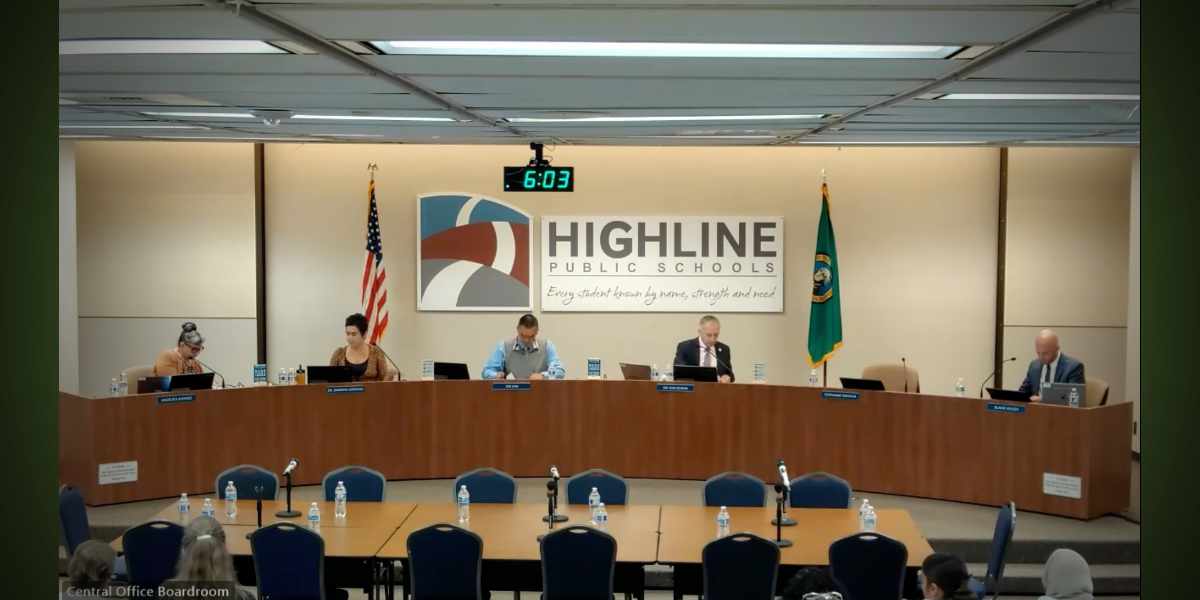
The Highline School Board convened on Wednesday, June 3, 2026, for a nearly three-hour discussion on hot button items that included classified staff relocation, transparency concerns, and more.
While there was not an official June proclamation, the board recognized National Safety Month, Pride Month, Flag Day, and Juneteenth.
Highline Education Association President Jeb Binns took a few moments to recognize and thank retiring staff members, as well as guest teachers. Binns encouraged acceptance of all students and community members as a sponsor of Burien Pride.
Mobile Devices
SB 5346 (companion bill HB 1122) addresses student use of mobile devices in public schools. The Superintendent Student Leadership Team urged policymakers to utilize student perspectives in decision-making. The new policy is slated for implementation on June 11, 2026.
The Superintendent Student Leadership Team meets monthly at different schools throughout the year, offering leadership lessons and values-based leadership opportunities. Guest speakers from Evergreen and Tyee shared their findings on cell phone and social media usage, as well as access to smart devices. The survey included feedback from an estimated 946 students, 35 staff members, and close to 100 parents, according to their presentation.
“Phones affect the learning environment every day, so the rules around them can shape whether the classroom feels safe and focused, and also respectful and fair,” the group offered. “So when expectations are clear and consistent, students are most likely to feel able to understand the boundaries and make more responsible choices.”
The student leaders emphasized the need for transparency and inclusion for non-traditional circumstances, such as students using their mobile devices for familial interaction, translation apps, and general anxiety reduction.
“And some students have to text their parents because some of them have to pick up their siblings or other family members, or let their family know where they are, because some parents work while school hours happen, and they want to know where their students are (and their kids) – and if they’re safe,” the group relayed.
They said in conclusion, “As a policy is developed, families need clear, consistent information so they will understand the expectations, the reasons behind them, and how the policy will affect the students’ day-to-day. It is also important to make sure communication is accessible in different languages because families cannot support a plan if they do not fully understand it.”
2026 Bond Recommendation
The community-led Capital Facilities Advisory Committee (CFAC) presented its 2026 bond recommendation at the meeting. Co-lead Tova Tupper started by saying, “This community-led group has spent the past two years studying Highline’s facility needs and developing a recommendation for the board’s consideration. Additional co-leads were Jackie Bryan and Omaha Sternberg.
“The CFAC was formed in 2015 to support bond planning and has successfully recommended the 2016 and the 2022 bond packages,” Sternberg said. “Membership includes appointed representatives from local jurisdictions, high schools, labor, and community organizations. And about half of CFAC members are also selected through a lottery process. Our committee charge was to develop recommendations for future facilities. This is not easy work, as you can imagine, and requires hard decisions, thinking about the needs of students in our district as a whole, and not just in our own neighborhood.”
The committee’s bond recommendation includes two full replacements, two partial replacements, and additional funding for design work and critical needs.
Student co-chair Cheryl Forbes said:
“This $595.4 million bond package invests in Highline’s future by bringing our deteriorating neighborhoods’ middle schools up to modern safety and learning conditions, just as our community has done for our neighboring high schools.”
Eric Hustad, the father of a fifth-grade student at Hazel Valley, said:
“For Sylvester, CFAC recommends rebuilding Sylvester Middle School at the existing site based on urgent building system maintenance and safety needs. Sylvester’s campus includes multiple aging buildings, with some dating back to 1953. The school’s overall building condition is well into the poor category. CFAC believes rebuilding Sylvester at the current site is the most fiscally responsible approach and would provide students with a modern, safer learning environment.”
Hustad continued, “CFAC recommends rebuilding Cascade Middle School at the Salmon Creek site based on student safety, long-term site feasibility, and fiscal responsibility considerations. Cascade’s current campus includes multiple aging buildings dating back to 1957. CFAC reviewed significant challenges with rebuilding at the current site, which includes wetlands buffers, a large sewer easement, limited buildable space, and the need for a more complex multi-story design. After reviewing conceptual site plans and cost estimates, CFAC concluded the nearby Salmon Creek site provides a more practical and buildable location for a new middle school campus. Rebuilding Cascade at Salmon Creek will save $44 million compared to rebuilding at the current site.”
Hustad said CFAC “asked for and read community input, including a group of Salmon Creek neighbors who are concerned about Cascade being rebuilt adjacent to them, and community concerns about what would happen to the garden hosted on the school property.” CFAC members were strong in their consensus to prioritize students and their needs above other factors while also making the most fiscally responsible long-term decision for Highline.”
CFAC members “understand there will be extensive opportunity through the permitting traffic and feasibility review processes to study impacts in greater depth and address neighborhood concerns,” Hustad added.
“CFAC recommends a major rebuild and modernization of Chinook Middle School based on aging facilities, declining building systems, and equity with other neighborhood middle schools,” said CFAC member Terri Hewitt. Hewitt is an alumni of Tyee High School and the parent of three children who graduated from Mount Rainier High School.
“The recommendation includes replacing several buildings with new construction, while modernizing portions of the existing campus where it makes sense to do so,” Hewitt added. “The redesigned campus would create updated learning spaces for programs like career and technical education, science, art, and music, while improving safety and overall learning conditions for students.”
Choice Academy is currently housed in the district’s lowest-rated school building. The CFAC recommends rebuilding the Southern Heights site “using insurance funding already available following the 2024 arson fire, while renovating portions of the existing classroom wings,” Hewitt said. “CFAC believes this project creates an opportunity to provide Choice students and staff with a modernized learning environment designed around the needs of the program and school community. While also maximizing available insurance dollars to reduce the overall impact of the bond funding.”
Katie Kresly said she served on the CFAC for the past three years and challenged:
“For the committee described as community led, but [composed] of 50% hand-selected members, that raises questions. If transparency, equity, and being a good neighbor are true priorities, then community members deserve meaningful opportunities to be heard in person before major decisions are made and finalized. That’s how trust is built, and that’s what being a good neighbor looks like.”
The CFAC said they also considered potential rebuilds or major modernization projects for both Hilltop Elementary and Valley View Early Learning Center.
“Ultimately, members prioritized the schools and projects previously discussed based on urgency, student impact, and available funding,” Hewitt added. “At the same time, CFAC recognized both schools have facility needs and recommends including funding for initial design work and targeted critical need improvements at both sites while they await a future bond.”
The committee made the recommendation to set aside $40 million for critical facility needs district-wide, allowing Highline to address required building system upgrades, emergency repairs, and site improvements.
Raisbeck Aviation High School
Multiple pleas for outgoing Raisbeck Aviation High School Principal Therese Tipton to be allowed to attend graduation on June 11 radiated throughout the room.
“For four years, Principal Tipton has shown up, not as a title, but as a person. She has celebrated these students and their victories manual or measured in a performance metric. It is earned slowly, consistently, one student at a time,” said commenter Amy Ely. “Today, 92 seniors stand on the threshold of one of the most significant moments of their lives. They are proud, they are ready, and many of them are hurting, because the principal who walked with them through four years of growth may not be allowed to witness the moment they cross the finish line.”
Ely continued, “What we do not understand is why student voices carry so little weight in a decision that directly affects their experience. They are not abstract stakeholders. Graduation is not about policy or politics. It’s about students, always has been. Everything we do as educators, leaders, family members, and community partners exists to serve them.”
“When you removed Ms. Tipton, you left an enormous void,” said Rehana Meyer, a parent of a sophomore attending Raisbeck Aviation High School. “She is the backbone of Raisbeck. Her dedication to her staff and students is a major reason this school is successful, and we want her back.”
Cascade Relocation
Third-generation White Center resident Haley Matsui commented, “My grandmother taught in Highline schools, my mom and I attended Highline schools, and I am expecting my first child, who will be a fourth-generation Highline student, and a future Cascade Middle School student. So this upcoming bond to rebuild middle schools in our district is really personal to me, because I’ve heard, and more tonight, that there is talk that Cascade might be left out of this bond.”
Matsui added, “My mom went to Cascade in the ’70s and also remarked that it needed to be rebuilt back then. And so learning that rebuilding Sylvester and Chinook, but not Cascade, feels really unacceptable to me, and it’s not an equitable option. I am a future Cascade parent, and I care deeply about North Berrien, White Center, and every middle school across the district deserves to be rebuilt, not just those in the wealthier south end. Let’s not leave behind the communities that have been historically underserved.”
Mika Sundberg, a parent of students at Hazel Valley Elementary and Cascade, is also the co-chair for Yes for Highline and has served on CFAC since 2018.
“For two years, CFAC reviewed enrollment projections, facility conditions, and tax impacts. Throughout the process, we worked to balance student needs with financial responsibility and considered how voters across the whole district would view the proposal. As part of our work, we asked the district to look at different options for several projects to see if there are ways to save money while still providing students with the schools they deserve. This included relocating Sylvester and Cascade to better sites, and consolidating Choice Academy and Big Picture at Southern Heights.”
Sundberg continued, “Not every option proved feasible. Relocating Sylvester proved more expensive than rebuilding on site, and Big Picture depends heavily on transit access and asked not to be included at this time. Concerns were also raised about relocating Cascade to Salmon Creek, though many in the Cascade community indicated a new location was okay if it resulted in a better school. Ultimately, CFAC recommended adding Chinook Middle School, along with Cascade and Sylvester, to the bond package, because investing in Chinook now allows the district to reuse portions of the existing building, avoiding higher costs in the future and ensuring all Highline Middle School students have the benefit of a new building.”
Current Cascade student Pascal Global spoke about why he felt his school should be replaced.
“Cascade is very old school. It’s infested with roaches. The ceilings are caving in in some places. And as I’ve learned, the buildings are sinking,” Global said. “So when I’m in math class and all of a sudden, a roach comes out of nowhere, it disrupts the entire class. And kids are yelling, and it’s hard to focus. So it would be good to have a new school because being in an old school, it feels somewhat unsafe, and it’s always having to be [repaired].”
Carson Ivins asked the board to reconsider building Cascade at the Salmon Creek site and instead rebuild Cascade at the shared Evergreen Cascade campus.
“As many of you have seen, there is a petition signed by nearly 400 Burien area residents asking the board to take a closer look at these concerns before adding it to the bond package,” Ivins said. “What concerns us is that one of the district’s largest middle schools is now being proposed for one of its smallest sites. Salmon Creek is only 6.65 acres, while Washington State siting guidelines recommend five usable acres plus one acre per 100 students and an additional five acres for schools serving grades above sixth grade, which puts the Salmon Creek site at almost one-third the space recommended.”
Additional public comments can be viewed in the video below.
Video
Watch video of the full this school board meeting:
EDITOR’S NOTE: The author of this story is a CFAC committee member and worked on the 2026 bond package recommendations. She is dedicated to fair and accurate reporting.